

Invasive plants · 4 min read
Hemlock is one of the most poisonous plants growing wild in the UK, and it often turns up in gardens, on overgrown plots and along ditches and riverbanks. It belongs to the same family as cow parsley, so it is easy to mistake for something harmless. This guide covers the two plants most often called hemlock, how to recognise them, and how to deal with them safely.
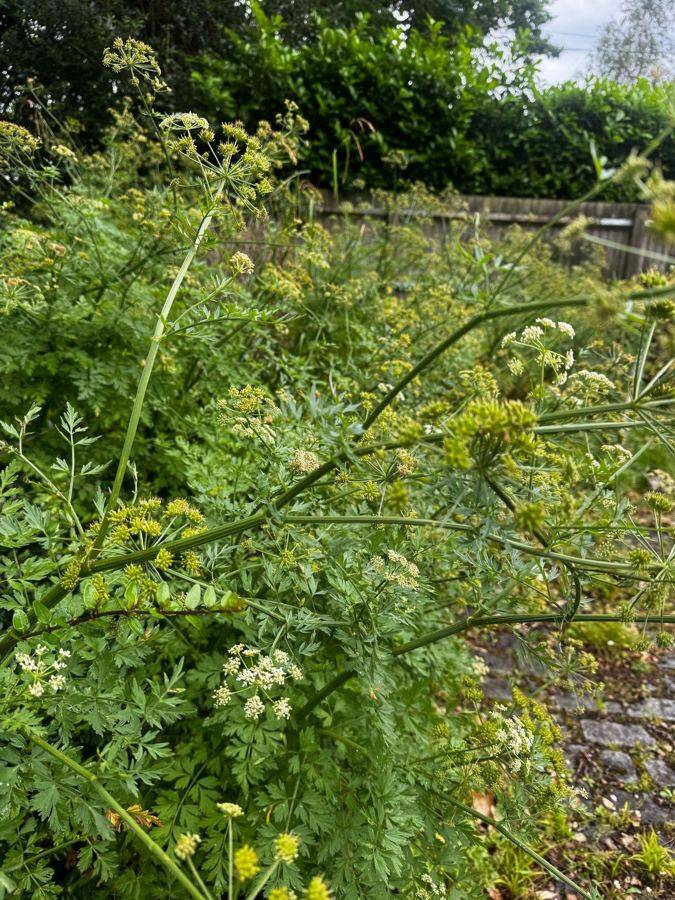
Do not eat, chew or taste any part of a plant you think might be hemlock. Wear gloves, keep children, pets and livestock away, and send us a photo for a free ID.
Which plants are called hemlock?
In the UK, hemlock is a common name used for more than one plant. The two most often meant are poison hemlock, which grows on rough ground, verges and overgrown gardens, and hemlock water-dropwort, which grows in wet places such as ditches, stream banks and riverbanks. Both are native, both are highly poisonous, and both belong to the same family as cow parsley, with white, umbrella-shaped flower heads. The names are often mixed up, and the name water hemlock is used loosely too, so it is best to treat any plant called hemlock with the same caution.
What to look for
- Tall, branching plants, often taller than an adult
- Hollow stems, which on some hemlock plants have purple blotches, spots or colouring
- Finely divided, fern-like or parsley-like leaves
- Small white flowers in umbrella-shaped clusters in summer, followed by seed heads
- Plants growing in damp ground or near water need particular care
Plants that look similar
Cow parsley, hogweed, wild carrot and wild angelica all have similar umbrella flower heads. Giant hogweed has purple-blotched stems too, and its sap causes skin burns in sunlight. Telling these plants apart can be difficult even for experienced gardeners, so if in doubt, treat the plant as dangerous and get it identified.
Not sure what you are dealing with? Send us a photo for a free ID, or book a free in-person survey. Book a free survey · WhatsApp us
Why hemlock is dangerous
All parts of hemlock plants are toxic if eaten, including the leaves, stems, seeds and roots. Poisoning can be serious and can be fatal. The sap can also irritate the skin of some people. Animals are at risk too, including dogs, horses and livestock.
Staying safe around hemlock
- Wear gloves, long sleeves and eye protection if you have to work near it, and wash your hands and tools afterwards
- Never eat, chew or taste any part of the plant, and keep children and pets away
- Do not burn it: the smoke from burning plant material is best avoided
- Do not compost it or leave cut material where livestock, horses or pets can reach it
- If someone may have swallowed any part of the plant, seek urgent medical help (call 999 or NHS 111) and take a sample or photo of the plant with you
Is there a law about hemlock?
Hemlock is a native plant. It is not listed on Schedule 9 of the Wildlife and Countryside Act 1981 (which covers Japanese knotweed), and it is not on the UK list of invasive alien species of special concern that covers giant hogweed and Himalayan balsam. Even so, cut material should be disposed of responsibly. Plant waste we remove from site goes via a registered waste carrier.
How we deal with hemlock
We start by identifying the plant, because the right approach depends on the species and the site, especially near water. Removal is carried out with protective clothing, using careful excavation, herbicide treatment where it is appropriate for the site, or a combination. Waste is bagged and removed from site, and the area can be monitored for regrowth from seed.
Find out more on our hemlock removal page.
Send us a photo through the enquiry form or on WhatsApp for a free ID, or book a free survey with a written report and photos and a fixed price quotation, plus VAT. We work across the South East of England.
Frequently asked questions
Is hemlock poisonous to touch?
All parts are toxic if eaten. Touching it is much less dangerous, but the sap can irritate some people's skin, so wear gloves and wash your hands afterwards.
How can I tell hemlock from cow parsley?
Hemlock is often taller, and some hemlock has purple-marked stems, but they can be hard to tell apart. If you are not sure, treat it as dangerous and send us a photo.
Are all types of hemlock poisonous?
Yes. The plants commonly called hemlock in the UK are all highly poisonous, so treat any of them with caution and get them identified.
Can I put hemlock in my green waste bin or compost?
Do not compost it. Bag it carefully while wearing gloves and ask your council or a specialist about disposal, or ask us to remove it.
Do you remove hemlock?
Yes. Send us a photo for a free ID, then we will survey and quote a fixed price, plus VAT.
Related articles
- Giant hogweed: safety first, then identification and removal
- Himalayan balsam: how to identify and remove it
- How to identify Japanese knotweed, season by season
Send us a photo for a free opinion
Not sure what is growing in your garden? Send us a photo and we will tell you what it is and what we would recommend, free and with no obligation. Or book a free in-person survey with a written report and a fixed price quotation.