

Bamboo · 3 min read
Bamboo is often sold as a fast, easy screening plant. Whether it stays where you planted it depends on what type it is. This guide explains the difference between running and clumping bamboo, how to tell which one you have, and how root barriers work.
Running bamboo: the one that travels
Running bamboos spread by long underground rhizomes that grow sideways away from the parent plant, then send up new canes some distance away. This is the bamboo that turns up in the middle of a lawn, under a patio or on the other side of a fence. Many popular screening bamboos sold in garden centres are running types.
Clumping bamboo: slower, but not maintenance-free
Clumping bamboos (for example Fargesia) have short rhizomes, so the clump grows outwards gradually rather than sending runners across the garden. They are much easier to live with, but an established clump can still become large, dense and hard work to dig out by hand.
How to tell which bamboo you have
- New canes appearing a long way from the main stand usually point to a running bamboo
- Canes coming up through paving, decking or the lawn are a strong sign of running rhizomes
- A tight, dense clump that widens slowly is more typical of clumping bamboo
- If you are not sure, send us a photo and we will identify it for free
What does a root barrier do?
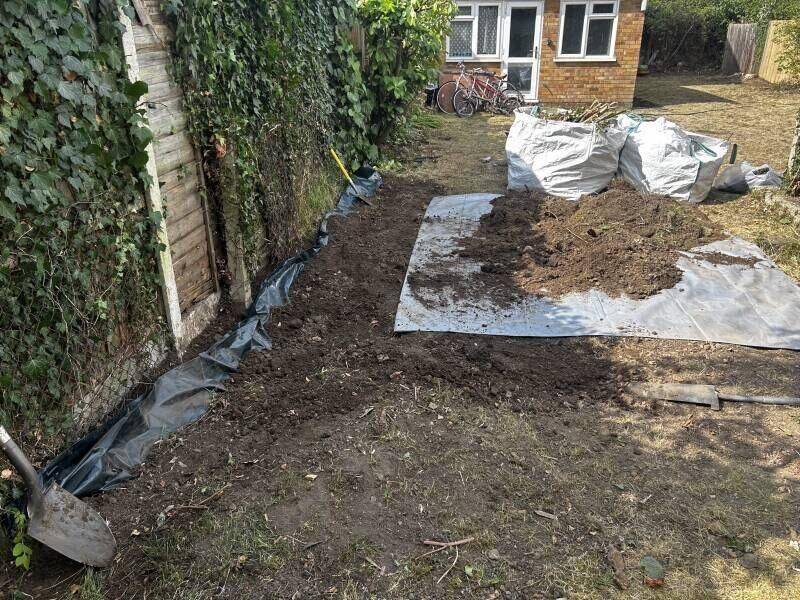
A root barrier is a tough membrane installed vertically in a trench to stop rhizomes passing through. It can be used in two ways: around a stand you want to keep, to contain it, or along a boundary to stop bamboo coming through from a neighbour's garden.
Why root barriers fail
Barriers only work if they are deep enough, continuous and properly joined, with the top edge left proud of the soil so rhizomes cannot simply hop over. A barrier that is too shallow lets rhizomes run straight underneath.
Before a barrier goes in, any rhizome that has already crossed the line has to be dug out. Otherwise the barrier simply traps bamboo on your side.
Not sure what you are dealing with? Send us a photo for a free ID, or book a free in-person survey. Book a free survey · WhatsApp us
Removal, barrier or both?
There is no single answer. It depends on where the bamboo started, whether you want to keep any of it and what is on the other side of the boundary. At the free survey we look at the spread and recommend excavation, a root barrier, or a combination. The quote is fixed price, plus VAT. See how much bamboo removal costs for what affects the price, or our bamboo removal service page.
Frequently asked questions
Is clumping bamboo safe to plant?
Clumping bamboos spread far more slowly than running types, but they still get large. Plant with enough room and check the species before you buy.
Can a root barrier stop my neighbour's bamboo?
Yes, a barrier along the boundary can stop rhizomes coming through, provided anything already on your side is removed first and the barrier is installed properly.
Why did my bamboo get past the barrier?
Usually because the barrier was too shallow, had gaps or poorly sealed joins, or was buried so rhizomes could run over the top.
Do you remove bamboo and install barriers in the same job?
Yes. We often excavate the stand and rhizomes and then install a barrier along the boundary.
Related articles
- Bamboo removal cost in the UK: what affects the price?
- Your neighbour's bamboo is coming into your garden: what can you do?
Send us a photo for a free opinion
Not sure what is growing in your garden? Send us a photo and we will tell you what it is and what we would recommend, free and with no obligation. Or book a free in-person survey with a written report and a fixed price quotation.