

Japanese knotweed · 4 min read
Japanese knotweed is sometimes called Japanese bamboo, because its stems look a bit like bamboo canes. The two plants are not related, and they are dealt with in different ways, so it is worth knowing which one you have. This guide compares them side by side. If you are still not sure, send us a photo and we will identify it for free.
The quick answer
- Bamboo canes are hard and woody, and they stay standing all year. Most bamboos keep their leaves in winter
- Japanese knotweed stems are softer, hollow and often speckled purple-red. The plant dies back in winter, leaving brown, hollow canes
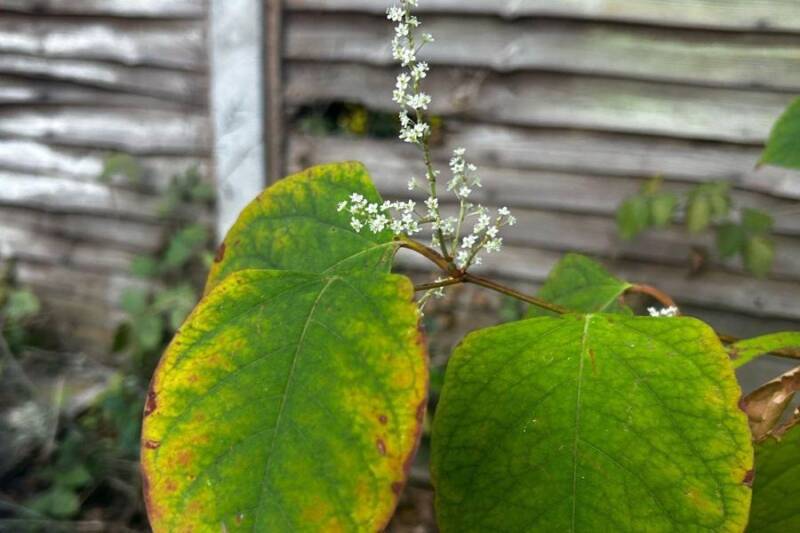
- Bamboo leaves are long and narrow, like grass. Knotweed leaves are broad and shield-shaped with a flat base, and grow in a zig-zag along the stem
Not sure what you are dealing with? Send us a photo for a free ID, or book a free in-person survey. Book a free survey · WhatsApp us
Bamboo vs Japanese knotweed, side by side
| Bamboo | Japanese knotweed | |
|---|---|---|
| What it is | A grass. Running types spread by underground rhizomes, clumping types stay tighter | A herbaceous perennial, not a grass. It spreads by rhizomes and from small fragments of root and stem |
| Stems | Hard, woody canes with solid joints. Green, yellow, brown or black, depending on the type | Hollow stems with raised joints, green with purple-red speckles. They snap far more easily than bamboo |
| Leaves | Long, narrow and pointed, like a blade of grass | Broad, shield or spade-shaped with a flat base, usually around 14cm long, in a zig-zag along the stem |
| Flowers | Rarely seen in gardens | Clusters of small creamy-white flowers in late summer and early autumn |
| Winter | Most stay green, with canes and leaves all year | Dies back. Leaves fall and stems turn brown, leaving dry, hollow canes |
| Spring | New canes push up from the ground, often some way from the clump | Red-purple shoots, a bit like asparagus, grow from pink buds at ground level and grow very fast |
| Underground | Rhizomes, usually fairly near the surface | Rhizomes that can go down 1m or more. A freshly snapped rhizome is orange or yellow inside |
| The law | Not listed on Schedule 9 of the Wildlife and Countryside Act 1981 | Listed on Schedule 9: an offence to plant it or cause it to grow in the wild. The waste is controlled waste |
Canes and stems
Squeeze or tap a cane. Bamboo is hard and woody, and old canes stay standing for years. Knotweed stems are hollow and softer, and they die back every winter.
Leaves
This is usually the quickest check. Bamboo leaves are long, narrow and grass-like. Knotweed leaves are broad, with a flat base where they meet the stalk, and they alternate from side to side, so the stem zig-zags.
Spring shoots
Bamboo sends up new canes from its rhizomes, sometimes well away from the clump, through lawns and paving. Knotweed comes up as red-purple shoots, a bit like asparagus, that grow very quickly.
In winter
Winter is when the two look most different. Most bamboos stay green. Knotweed dies back to brown, hollow canes, but the rhizomes underground are alive and will regrow in spring.
Underground
Both spread by rhizomes, which is why cutting the tops off does not get rid of either. Knotweed rhizomes can go deeper, and small fragments can grow into new plants.
Other plants that get mistaken for knotweed
The RHS lists several plants that are commonly confused with Japanese knotweed, including Russian vine and Himalayan honeysuckle. Giant knotweed and the hybrid Bohemian knotweed look similar too. See our other knotweeds page and our season-by-season knotweed guide.
Why it matters which one you have
Running bamboo is usually dug out, rhizomes and all, or contained with a root barrier. Japanese knotweed is usually treated with herbicide or stem injection, excavated, or both, and it comes with extra rules on waste and on declaring it when you sell a house. Getting the ID right means the right plan and the right paperwork. See bamboo removal, Japanese knotweed and selling or buying a house.
Send us a photo for a free ID
Take photos of the leaves, the canes or stems and the whole plant, with something for scale if you can. Send them on WhatsApp or add up to 5 photos to the enquiry form, and we will tell you what it is, free of charge.
Not sure what you are dealing with? Send us a photo for a free ID, or book a free in-person survey. Book a free survey · WhatsApp us
Frequently asked questions
Can Japanese knotweed look like bamboo?
Yes. Its hollow stems with raised joints look a bit like bamboo canes, which is why it is sometimes called Japanese bamboo. The leaves, and the way it dies back in winter, are the easiest ways to tell them apart.
Does bamboo die back in winter like knotweed?
Most bamboos keep their canes and leaves through the winter. Japanese knotweed dies back, leaving brown, hollow canes.
Can you identify it from a photo?
Usually, yes. Send clear photos of the leaves, the stems and the whole plant on WhatsApp or through the enquiry form. If we cannot be sure from photos, we can look at it on a free survey.
I think I have both. Can you deal with them together?
Yes. We can survey both at the same visit and quote for each, with a fixed price plus VAT.
Related articles
- How to identify Japanese knotweed, season by season
- Running vs clumping bamboo, and when you need a root barrier
- Japanese knotweed: herbicide treatment vs excavation
Send us a photo for a free opinion
Not sure what is growing in your garden? Send us a photo and we will tell you what it is and what we would recommend, free and with no obligation. Or book a free in-person survey with a written report and a fixed price quotation.