

Invasive plants · 5 min read
Giant hogweed (Heracleum mantegazzianum) is one invasive plant you should not touch. Its sap can cause severe skin reactions when skin is then exposed to sunlight. This guide covers how to recognise it from a safe distance, what to do after contact, and how it is removed.
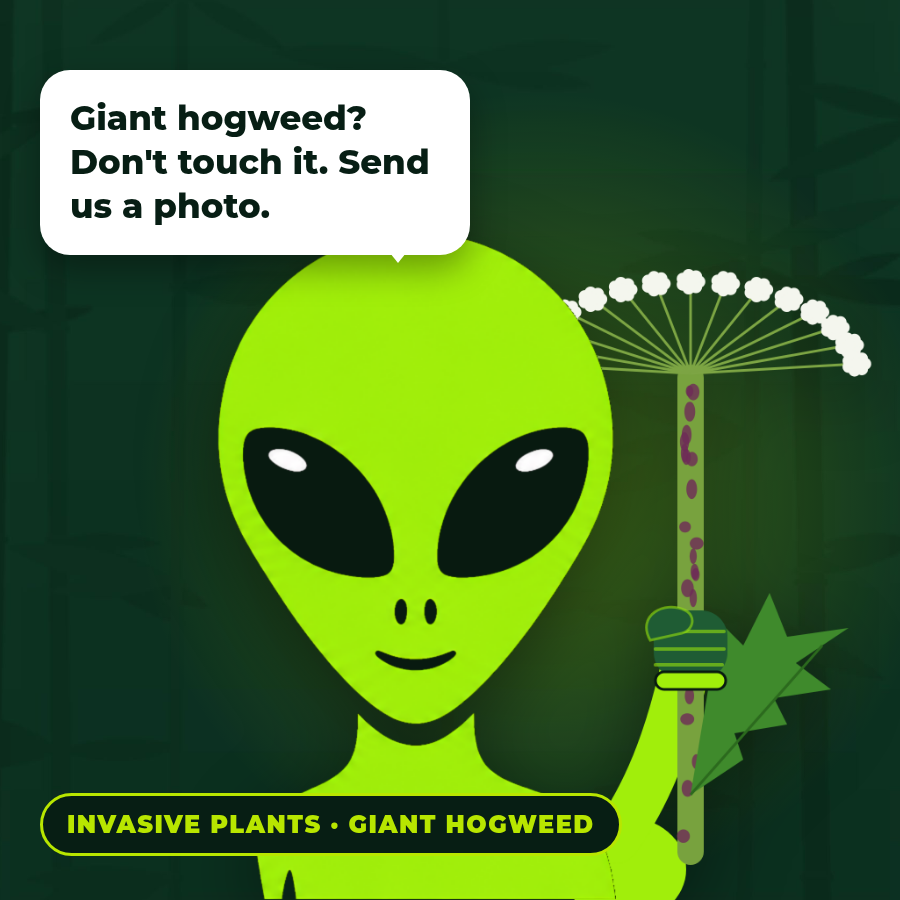
Do not touch, cut or strim giant hogweed. If you think you have it, keep children and pets away, take a photo from a distance and send it to us.
Why giant hogweed is dangerous
The sap contains chemicals that make skin extremely sensitive to sunlight. Contact followed by sun exposure can cause painful blistering burns, and the affected skin can stay sensitive to sunlight for a long time afterwards. Getting sap in the eyes is particularly dangerous.
If you come into contact with the sap
- Wash the skin thoroughly with soap and cool water as soon as possible
- Keep the area covered and out of sunlight
- Seek medical advice (for example NHS 111), and urgently if sap gets in your eyes or you develop blisters
How to identify giant hogweed (from a distance)
- Very tall: mature plants can be much taller than an adult
- Thick, hollow, green stems with dark purple blotches and coarse white bristles
- Huge, deeply divided, jagged leaves
- Large white umbrella-shaped flower heads in early to mid summer
Plants that look similar
Native hogweed and cow parsley are much smaller and are often mistaken for giant hogweed. Hemlock also has white umbrella flowers and purple-spotted stems and is highly poisonous. Do not handle any of them without knowing what they are. A photo is the safest way to get an ID.
Not sure what you are dealing with? Send us a photo for a free ID, or book a free in-person survey. Book a free survey · WhatsApp us
Alien species, by Alien Plant Control
Giant hogweed and the law: an invasive alien species of special concern
Giant hogweed is on the UK list of invasive alien species of special concern. The list comes from the EU Invasive Alien Species Regulation (EU) No 1143/2014, the EU law that people sometimes search for as the EU invasive alien species directive. The Regulation was kept in Great Britain's law after Brexit, and in England and Wales it is enforced through the Invasive Alien Species (Enforcement and Permitting) Order 2019, often called the IAS Order 2019. Two related plants, Persian hogweed and Sosnowsky's hogweed, are also on the list.
What the rules say
- You must not intentionally keep, grow or cultivate it, let it reproduce, breed it, transport it, sell it, use or exchange it, or release it into the environment
- The rules also cover live parts that could grow, such as seeds, roots and cuttings
- Live material can only be moved off your land to a facility for destruction, or under a licence from Natural England (Natural Resources Wales in Wales) or a permit from the Animal and Plant Health Agency
What it means for homeowners and landowners
It is not an offence for giant hogweed to be growing on your land. Defra does not treat plants that are already growing there as being kept or cultivated, and landowners do not have to remove plants growing wild.
However, you must not plant it or intentionally let it spread. GOV.UK guidance says you should treat or dispose of it where possible and not allow it to grow or spread outside your land.
In England, Defra, the Environment Agency, Natural England and the Forestry Commission can ask an owner to agree a species control agreement to deal with invasive non-native plants, and can make a species control order if that does not work (for homes, only the Secretary of State can do this). Penalties under the IAS Order range from warnings and notices to fines and, for the most serious offences, prison.
Why using a professional matters
- Biosecurity on site, so seeds and fragments are not carried away on boots, tools or vehicles
- Plant material and contaminated soil can count as controlled waste, so it is taken away by a registered waste carrier to an authorised site
- A plan that stops it spreading from your land to your neighbours' gardens or into rivers
Before 1 December 2019, giant hogweed was listed on Schedule 9 of the Wildlife and Countryside Act 1981. Its entry was removed from Schedule 9 when the IAS Order 2019 came into force, and it is now covered by the Order instead.
How giant hogweed is removed
Removal is carried out with full protective clothing and eye protection, using herbicide treatment, careful excavation, or a combination, depending on the site. The site is monitored afterwards because seeds in the soil can germinate in later years. Bio-security measures stop seeds and plant material being carried off site.
Find out more on our giant hogweed removal page.
We treat giant hogweed as well as other invasive plants. Send us a photo for a free ID, or book a free survey with a written report and photos and a fixed price quotation, plus VAT. See also our Himalayan balsam guide.
Frequently asked questions
Is it illegal to have giant hogweed in my garden?
No. It is not illegal for giant hogweed to be growing on your land. But you must not plant it or intentionally let it spread, and moving it off your land or disposing of it the wrong way could be an offence. If in doubt, ask us or check the GOV.UK guidance.
Is giant hogweed dangerous to touch?
Yes. The sap can cause severe burns when skin is exposed to sunlight. Do not touch it, and keep children and pets away.
What should I do if I touch giant hogweed?
Wash with soap and cool water, keep the skin out of sunlight and seek medical advice, urgently if sap reaches your eyes.
Can I strim or mow giant hogweed?
No. Strimming sprays sap and is a common cause of injury. Leave removal to a specialist with full protective equipment.
Do you remove giant hogweed?
Yes. Send us a photo for a free ID, then we will survey and quote a fixed price, plus VAT.
Related articles
- Hemlock in the UK: how to identify it and stay safe
- Himalayan balsam: how to identify and remove it
- How to identify Japanese knotweed, season by season
Send us a photo for a free opinion
Not sure what is growing in your garden? Send us a photo and we will tell you what it is and what we would recommend, free and with no obligation. Or book a free in-person survey with a written report and a fixed price quotation.